
#13: Responding to Authoritarianism with Renewed Investor Mindsets and Systems Change Investing
Investing Capital to Create Positive Change Across Themes

Summary Overview
In this, Part Two of the previous post, we move from discussing the importance of mindset shifts to then evolving our thinking to new paradigms of systems change impact investing as one response we may bring to the present moment.

Renewed Mindsets as Paradigms of Systems Change and…
With the individual now placed in the context of the Other, each of our mindsets may now more effectively evolve into larger, connected world views and paradigms.
In terms of our interest in responding to rising American Authoritarianism, a recent essay introduces a full issue of the magazine Noema on the topic of shifting paradigms, Nathan Gardels outlines the tension between nationalism and global paradigm shifts. You can read the complete essay here: (NOEMA).
Briefly, Gardels defines a paradigm shift as the replacement of one organizing worldview with an entirely new one. Despite the global slide toward nationalism and multi-lateralism, he argues the current paradigm is shifting away from globalization (cross-border markets, trade, and technology) toward a planetary paradigm: recognizing Earth as an interdependent system embedding human civilization.
Enabled by satellites, sensors, and cloud computing, this planetary awareness reframes geopolitical realism as Gaiapolitik—politics aimed at securing a livable biosphere for all. However, Gardels contends contemporary geopolitics is heading in the opposite direction: toward renewed nationalism and sovereigntist tendencies rather than planetary cooperation. He frames this as backsliding from liberal universalism and the post-1945 rules-based order, now being discarded by powers like the U.S., China, and Russia through tariff wars, fractured alliances, and imperial ambitions.
Gardels outlines a seismic paradigm shift (from globalization to planetary consciousness) driven by technology and ecological urgency. Yet this shift is blocked by resurgent nationalism and rejection of liberal universalism, delaying collective reorientation toward planetary stewardship.
Mark Carney, PM of Canada, brought a different perspective to the discussion of our present paradigm shift in his address at Davos this past week. In his talk, Carney makes a clear and direct argument that our world has moved from a rules and institutionally based world order into a period where that order has now “ruptured” into a new, multi-lateral global order where the powerful dominate and leave the rest, the mid-tier and poor countries, to navigate best they can.
His talk is excellent—and definitely worth listening to as it correctly outlines many of the elements of the shift now taking place and into which the rise of authoritarianism is playing such a direct and forceful role.
…Systems Change Investing as Paradigm Shift
As global crises—from ecological collapse to systemic inequality—intensify, for a sizeable minority investor expectations are shifting beyond short‑term returns to cultivating regenerative economic systems. These investors bring a more holistic, integrated paradigm to bare, looking for opportunities to profit from the shifts taking place while aligning their capital investments with a deeper vision of sustainable economics, the interconnected fundamental nature of the world (perhaps a place in between Gardels and Carney), and our opportunity to shift the global economic order beyond the limits of traditional, extractive financial capitalism.
Systems‑change investing (SCI) re-frames capital as a transformational force that targets root causes rather than surface symptoms.
The AtA Series is based upon the conviction that our community of financial innovators and impact entrepreneurs offers at least part of a solution for our times by pioneering new financial tools that have the potential to bring economic agency to a all actors and promoting integrated, sustainable economic models. By addressing many of the issues of interest to those supporting the rise of strong men and a disrupted global order, impact investing becomes a tool of positive change and transformation from old to new.
Others have written on this topic and its challenges for tying investments to true impact and positive change. Asset owners and fiduciaries are increasingly drawn to this lens, recognizing enduring impact requires shifting the dynamics, feedback loops, and incentives within complex systems—whether financial, environmental, or social. Organizations like Twist, the MIT Sustainability Initiative and many others cited below are helping build communities of practice pioneering SCI frameworks that aim to co-design new finance mechanisms to catalyze deep, structural change.
Twist, a leader in systems‑change labs and financing design, works with investors, government agencies, and coalitions to re‑architect capital flows to amplify equitable outcomes. Its case studies emphasize leveraging tools such as blended finance and outcome‑based instruments to shift ownership models and governance dynamics. Twist’s methodology typically involves cross‑sector co‑creation:
defining the systemic barriers,
designing financial tools that align with those insights, and then
deploying capital in a way that reshapes incentives.
Twist proposes asset owners engage meaningfully in SCI by catalyzing new investment models that de‑risk innovation and redistribute power within ecosystems.
Another example is the role played by the MIT Sustainability Initiative which brings academic rigor and systems thinking to the domain of sustainable finance. By engaging researchers, investors, and practitioners, the initiative identifies leverage points where financial innovation can accelerate systems transformations. Their case studies (spanning renewable energy, urban resilience, and supply‑chain decarbonization) offer insights into how asset owners may mobilize capital structurally rather than incrementally. Investors informed by this approach deliberately allocate capital toward interventions that shift norms or policy feedback—such as incentivizing circular economy practices, or embedding decarbonization into asset class governance.
And TransCap Initiative has done excellent work advancing a vision of system change investing and documenting emerging best practices. In particular, Dr. Jess Daggers’ series outlining how we might approach a metrics and performance framework for systems change/systemic investing is a very solid contribution to the field and our efforts to go from broad vision to applied practice. Definitely worth exploring in depth.
Beyond these organizations, the broader SCI literature includes:
Bridgespan’s systems investing work,
University of Zurich’s CSP program on Systems Change Investing for Impact Investors,
the Shifting Systems Initiative of Rockefeller Philanthropy Advisors,
Impact Frontiers systems change metrics framework,
the Blink Systems Change Impact Investing Framework,
and others which underscore key levers in a process of changing economic order:
Mapping system actors and power dynamics,
Investing in intermediaries that shift norms, and
Balancing patient capital with performance incentives.
For asset owners, implementing SCI may mean reallocating capital toward catalytic, often hybrid instruments; committing to long‑term governance structures (often through the previously discussed Total Portfolio Management approach/framework; and co‑creating metrics that value system performance over traditional outputs.
The implications are profound:
SCI elevates the investor’s role from capital allocator toward systems steward and collaborator, capable of amplifying resilient, just, and regenerative system architectures.
This not only aligns with fiduciary duty in the face of systemic risk—but redefines fiduciary duty itself.
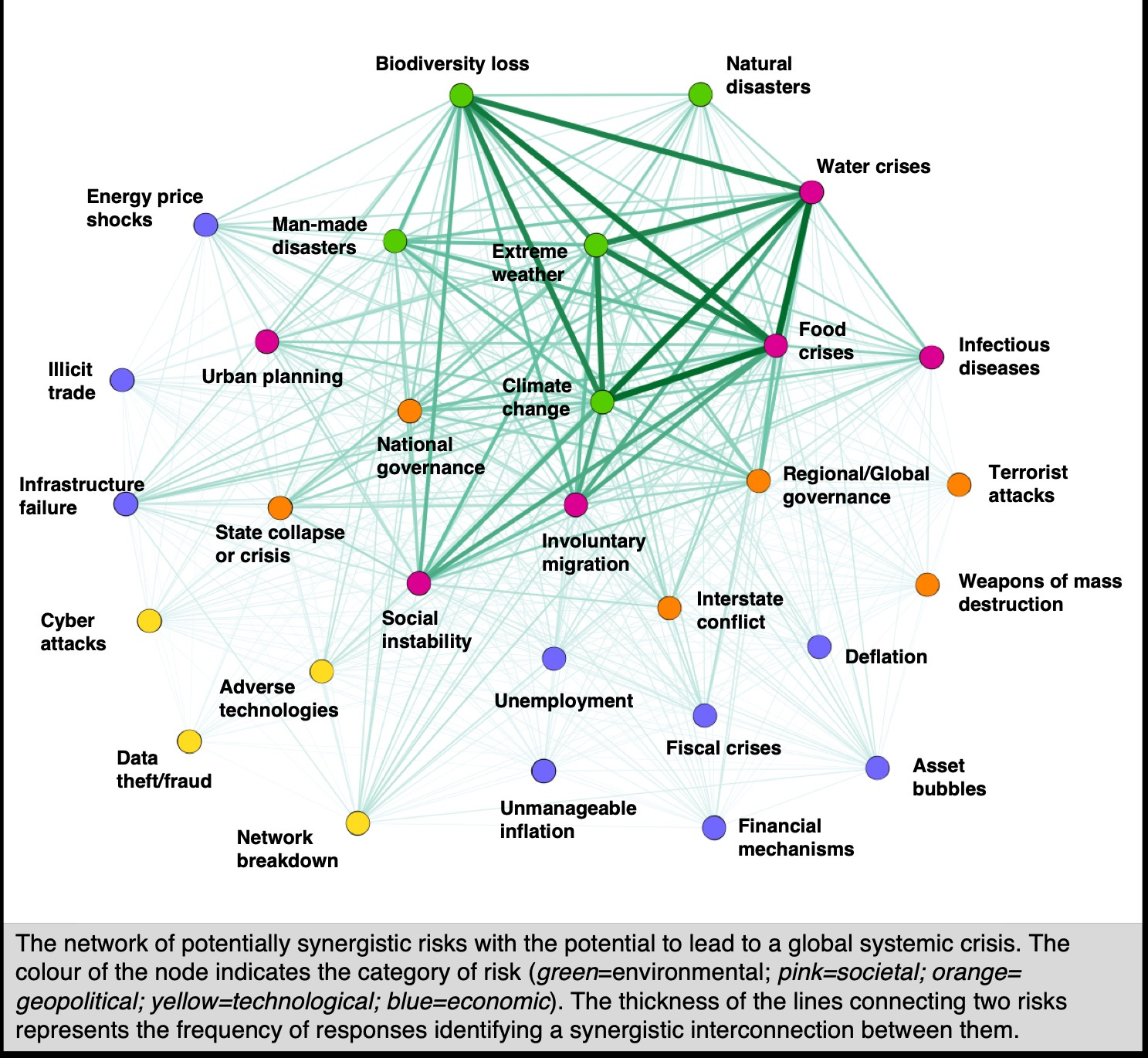
Taken from the excellent research report from Future Earth, the above graphic shows the intricate links between and among various issues of interest and concern to impact investors (and, uh, to pretty much anybody!). Bringing a systems lens to impact investing means viewing whatever thematic area you’re concerned with as simply one part of a much larger network of interconnected issues.
Acting to deploy capital to address one topic or theme naturally brings one to consideration of a much broader set of now inter-related issues. Rather than viewing our agenda as a series of parts, we must work to understand how the parts are actually a whole, a living neural network of inter-related phenomenon that works as a single living entity.
And this is a key idea—that systems are themselves not static structures, but living economic, social and environmental orders that pulse, evolve and change based on the interplay of their various parts.
The challenge for many engaged in systems change thinking, investing and advocacy is to maintain this understanding of systems as not mapped in real time and holding still as we maneuver our way through execution of our strategies, but continually adapting, thriving, living structures constantly shifting and moving from parts to whole.
Heiko Specking drove this point home with me in a recent conversation regarding the state of systems change thinking and investing. It certainly rings true.

Emerson, 2026
Systems Change Investing in Action: The Investment Integration Project
Founded in 2015 by Steve Lydenberg and William Burckart, The Investment Integration Project (TIIP) coined the term system-level investing to describe an enhanced operating system for investors—and for TIIP’s purposes defined the term as one that recognizes the reciprocal relationship between portfolio performance and the health of environmental, social, and financial systems.
Emerging from the evolution of sustainable and impact investing (many of TIIP’s concepts, such as executing a total portfolio approach to investing that deploys capital from across a continuum of philanthropy to near-market and market-rate investment strategies, assessing financial and extra-financial components of value and so on) clearly draw upon the work of other actors within the purpose driven capital community.
Importantly, the TIIP framework seeks to shift the focus from assessing individual companies and funds to influencing the broader structures, norms, and dynamics that shape long-term outcomes. TIIP’s work has addressed the challenge of making this perspective practical and actionable across asset classes and strategies, in service of durable, system-wide value creation.
The following section is an edited version of analysis offered by Bill Buckart of TIIP, defining their approach to systems level investing:
As outlined above, the language of “systems” has spread across the investment landscape and a growing array of adjacent frameworks has emerged—some valuable, others imprecise—often blurring critical distinctions.
TIIP’s leadership would argue system-level investing is frequently conflated with these approaches, despite being different: as envisioned by TIIP, systems change investing is grounded in an evolved understanding of fiduciary duty, designed for institutional portfolios, and oriented toward reshaping the structural conditions that underpin long-term market value.
While techniques such as systems stewardship (including engagement and proxy voting) sit within this framework, other models promoted in the community—such as systemic investing or investing for systems change—largely arise from philanthropic and impact traditions, emphasizing the role of philanthropic and near-market capital, ecosystem-level interventions, and alternative forms of accountability. These approaches are complementary rather than oppositional, with catalytic capital often serving as a proving ground that surfaces solutions later scalable by institutional investors.
The stakes for investors have only intensified. Climate disruption, democratic erosion, and capital market instability have exposed the limits of firm-level risk management and underscored a simple reality: portfolios cannot thrive if the systems on which they depend are failing. While responsible investing has evolved from data scarcity to data abundance, the binding constraint today is action.
Responding to this gap, TIIP developed the Systems Aware Investing Launchpad (SAIL), an AI-enhanced platform that helps institutional investors translate systems-level insight into implementation—supporting strategy design, peer benchmarking, coherent reporting, and deeper understanding of specific systemic risks.
In the next post of the AtA Series, the TIIP platform and tools will be applied to examine the dynamics of authoritarianism and their implications for citizen activists and long-term investors.
Conclusion
A renewed mindset, then, entails personal reflection upon how each of us as individuals acts on our own behalf, yet within a larger set of interconnected relationships ultimately coalescing into paradigms that highlight multiple and inter-connected systems of capital, community and personal action—all of which stand in direct and powerful opposition to the practices of nationalistic authoritarianism currently emerging in the world.
Our potential to mobilize purpose driven, impact oriented capital to offer a counter balance to the forces fueling fascism is limitless—we have the models, we have demonstrated much of the “how” to execute our strategies in response to the “why” of advancing greater economic agency, broader stakeholder ownership and enhanced equity (both as investments and as justice) in the world.
All of this is possible and within our reach.
All of it is also dependent upon our cultivating a renewed mindset and enunciating the transformed capital paradigms needed to more deeply understand and advance our work.
This renewed mindset must rest within a sense of and commitment to the possibility of what we might co-create as an alternative to the vision offered by sectors promoting the vision and practices of a new American Authoritarianism.
As Natasha Jolob observed to me in a direct email message:
The old world is collapsing under its own weight, there’s no need to fight it. Instead, we can channel our life force into creating what comes next. Reclaiming voice, staying grounded, and remembering that the evil forces behind this may have power and influence, but cannot dominate those who are in high states of consciousness and brave enough to build the new social economy. What a time to be alive 🤩💪we are in charge of building a whole new world and rewiring a new financial system 🤩
Or as Archbishop Desmond Tutu simply stated,
“We need to remain prisoners of hope!”
It is that hopeful mindset which ultimately gives us the vision and power to change and advance our work, together.
Personal Challenge:
How do you see the connection between a renewed mindset, shifts in paradigms and our understanding of how we show up in the face of fascism?
What are the dominant paradigms you feel you operate within?
What are the paradigms we need to shift in society?
How does this discussion look when set within our discussions of the present context and rise in authoritarian politics and the rise of tyranny?
Thanks for reading Antidote to Autocracy! This post is public so feel free to share it.
Author’s Note: While the final writing and analysis are my own, please know I did make use of various AI tools in research and drafts conducted for this project. For a fuller discussion, please see the closing Note in the first post of the Antidote to Autocracy series. Thanks!
It's interesting how this builds on your previous post. Gaiapolitik is truly mind-blowing!