
#6: On Capitulation to Autocracy
Introductory Considerations to Our Turning Away

Summary Overview
Over the course of recent months, part of our collective wonder has been regarding why it is that as the Administration rolled out its policies and agenda so many of our leaders and as well as many of us were left seemingly frozen in place.
This post reviews the overall notion of capitulation, placing it in historic context for how appeasement and capitulation to the rising force of authoritarianism have played out in previous moments of history.
We begin with a general reflection on the topic, look at how capitulation has been present in corporate America and then offer reflections on how capitulation looks within the impact investing community.
With those observations made, we turn to a discussion of how capitulation has historically occurred in nations around the world, reviewing various authors’ analysis of events as they took place in Hungary, Turkey, Russia, China and, more recently, the United States.
I then close with a short set of steps we might take to address this challenge.
Introduction: Why do people—why do we?!—capitulate?
Perhaps part of our sense of dismay in observing events of the past nine months is that some of us are old enough to remember when (while, of course, certainly never at all pure) there was a general sense that our political parties operated within a given set of basic ethical and ideological guardrails that steered their public work within certain bounds of what one might expect of a “conservative Republican” or “progressive Democrat.”
Yes, there were certainly bad apples in both orchards, but overall there was a greater commitment to nation and cause that broadly informed how we popularly viewed a calling to public service. This is why, back in the day, the acts of, say, a Lee Atwater or H.R. Haldeman were viewed with a degree of repulsion even among those who benefited from their actions or were willing to play in a grey zone when it came to politics, either in terms of ideology or process since it “meant something” to throw one’s hat in the ring with one Party versus another.
Over recent months many have been genuinely shocked to see the speed with which “Never Trumpers” or simply those who were not initially fans in the Republican Party acquiesced to the demands and parroted the obvious lies of the current President, while across the aisle with precious few exceptions, there was complete and total silence, with no coherent response to what has clearly been an—and to this point, successful—effort to establish in a matter of months the singular authority and power of the unitary executive.
Capitulation is rarely forced—it is chosen.
Each time we choose not to speak, not to resist, not to disrupt the comfortable status quo, we aid those who seek to control and repress initially the Other, but ultimately our Selves. History is littered with the cost of cowardice masquerading as pragmatism. In a time when democratic backsliding is global and coordinated, our response must be principled, strategic, and collective. The test of our age is not merely whether we resist authoritarianism, but whether we refuse to help build it through our actions: direct, indirect or from the sidelines within the reality of “inaction as action.”
Democracy dies not just when tyrants rise, but when good people look away.
Capitulation is often based out of greed, fear, pragmatism, self‑preservation, and/or illusions. Citizens, politicians, or businesses confronted by a strongman may perceive resistance as futile or too costly. Fear of repression—overt or covert—suppresses dissent. Despite the clear lessons of history, some believe accommodating or cooperating secures survival or access. Others convince themselves (thinking it is 2017 again?) they can moderate the regime from within—or that economic benefits justify moral compromise.
Psychologically, resignation may be rationalized: “We’ll lose jobs, markets, or stability otherwise.” But the paradox is real—and enabling demagogues strengthens their power, deepens repression, and over both long and short time frames corrodes democratic institutions.
Collective inaction can also stem from coordination problems: if dissidents think others won’t join, they free‑ride; the state’s repressive capacity reinforces this inertia (Wikipedia, SAGE Journals).
We, individually and collectively, operate within various rationale for why our capitulation is acceptable if not mandatory:
Stability “trumps” principle: Authoritarians contribute to chaos and then promise to then create controlled environments hostile to democracies struggling to deliver on their promise. We have traditionally expected corporations to especially value predictability over messy democratic dynamics—much less volatile markets—but this expectation along with so many others has been challenged as we have witnessed leaders in the business community consistently bend a knee in fealty to an aspirational king.
Economic necessity or opportunity: Trade, investment, or contracts—real or anticipated—make some see compromise as a cost of doing business. Some may also see investment and commercial opportunity they are willing to exploit even as they understand its larger implications for democracy and the values they have previously espoused.
Furthermore, in this new day, for the first time we see the government of the United States taking significant equity positions in what were independent, publicly traded companies but are now replications of state-owned enterprises formerly found only outside the United States. I suppose one could argue their leadership is responding to a new form of “economic necessity” as they seek to navigate the evolving rules of our increasingly authoritarian state.
Buffering collapse: Leaders or companies claim they can soft‑pedal abuses without inviting worse outcomes, or that restraint avoids provoking crackdowns.
Appeasement logic: Like early‑1930s Britain and France dealing with Germany, politicians sometimes cling to peace‑at‑any‑cost, hoping weak response avoids conflict—but it often only emboldens tyranny (Wikipedia).
History is replete with many and diverse examples of why appeasement and capitulation in the face of authoritarianism does not, even in the short term, work. I would offer just three to start and you may add to this list as you like:
U.S. politicians backing coups in the Global South
In the 1950s, the United States supported coups in Iran (1953), Guatemala (1954), and Chile (1973)—overthrowing democratically elected leaders—in order to secure alignment with U.S. business and geopolitical interests. These decisions prioritized short‑term stability and anti‑communist order over democratic principle (Wikipedia).
German industrialists and the Nazi regime (1930s)
Major firms like Krupp, IG Farben, BMW and Volkswagen actively cooperated with Hitler’s regime. They accepted state contracts, crushed unions, and profited from repression. In exchange, they were granted political favor—but at immense moral and later historical cost (act-global.com).
NBA’s Houston Rockets vs. China (2019)
After General Manager Daryl Morey tweeted support for Hong Kong protests, Chinese authorities imposed consequences: loss of broadcast deals, sponsorship revenue, and corporate access. U.S. sports leagues and executives quietly censored themselves thereafter—prioritizing market over democratic expression (axios.com).
Corporate Capitulation
And now we see this history played out again in our present.
Over this past year, many Americans have been disappointed, though perhaps not surprised, to see the speed with which business leaders of large corporations based in the United States have moved to embrace the current regime, abandoning statements of commitment to diversity or climate action, leaving initiatives and organizations that just weeks prior they had been proud and loud members of, and justifying doing so on the basis of economic expediency and political necessity. These former free market advocates (Geez… whatever happened to that commitment?) would be wise to reflect on how well capitulation and engagement has worked out for their colleagues in other countries, in particular Russia, where the outcome for the business community has been, shall we say, mixed.
And while understanding something of what is happening, the pressures they may be under and whether we would not respond in exactly the same way were we in their shoes, corporate capitulation must be viewed for what it is: blatant greed, base cowardice and corporate complicity in actively undermining the core values, norms, traditions and vision of what was already understood to be America’s hollowed out financial capitalism now no longer salvageable by marketing dollars, SDG initiatives and clever branding consultants.
Previously there have been those times when the corporate elite of America might have been viewed with at least some degree of respect and admiration. And to be fair, there have been outstanding examples of positive corporate citizenship by firms such as Costco or Greyhound Busline or other companies we don’t seem to hear much about, however they remain an exception to the current rule(r), with a seeming majority of American corporations following the more craven example of BlackRock.
More broadly, in today’s context corporate America has shown the depths to which society’s former Masters of the Universe have become fallen followers of the emerging authoritarianism that will ultimately engulf us all.
And to that, I offer a hearty and passionate
Thanks for that, guys!
We appreciate your good leadership and integrity!
Thanks for your service!
I mean, WTF?
And what of us? How is Impact Investing called to show up the the face of the New American Authoritarianism?
Let us not pretend corporate America stands alone and on its own, head bowed in a darkened corner. While some rhetoric and practices have shifted over the years, I have never turned to corporate or commercial America for moral or professional vision or leadership within impact investing, much less in this current moment.
There are others, however, who I had thought I might turn to and am now surprised to largely count among the absent and cowed, for our impact investing and social entrepreneur community has, in the public sphere, participated in its own process of quiet capitulation.
A central reason I was moved to engage in this research over these past months, write these posts over these last weeks and attempt to find my own voice in all this is that I have been surprised at the lack of coherent and consistent public response coming from our own community and its leaders.
I will say and not for the first time:
I definitely understand and appreciate the challenge of these times for those leading our field’s organizations.
I do get it and count myself among those who have been complicit in contributing to our community’s roaring silence.
I know what it means to be responsible for an organization, its stakeholders and sustenance.
And to fear what might happen were one to speak out too visibly in this moment.
I truly feel for our field and community.
To consolidate and paraphrase a couple of my recent conversations with fellow impact investment activists and managers (we can perhaps explore that difference…), I have been told:
These past months have been exhausting and have left us curled up in a fetal position on the floor. Under advice from our legal counsel, we’ve had to go through and scrub our web site of any DEI related statements, we’ve had to be cautious not to leave written records of our discussions and planning, and we’ve had to try to figure out how to support our portfolio while also working to remain off the radar of the Administration and its allies.
This isn’t what we signed up for! And, after witnessing what’s happening to others (Academics, former opposition leaders and so on) we are all genuinely scared about what is to come!
Believe me, even as I’m not running a fund or organization these days, I share these fears and sense of exhaustion—I can only imagine what it is like for those working to advance their impact strategies against the countervailing energy that has been unleashed over recent months and continues to advance by the day.
But know also the fear we may feel is nothing compared to the fear of those directly in the cross hairs—those members of our community who risk not only their jobs or organizations, but are actively stalked, harassed and incarcerated.
I spoke with one of our colleagues recently who, with literal tears in her eyes, described the comments she has received from neighbors and the deliberations she has had with her family regarding where they might possibly go at this point.
I keep her words in mind and heart as much as I do those of impact professionals who carry their own fears and challenges.
And know I am aware that by transitioning out of my previous role I have positioned myself to be able to speak more directly to the current time of authoritarianism addressed in this series. Know also I would exchange the limited number of words I have heard in our community for some measure of action. But as the old saying goes,
I cannot hear what you are saying, since what you are doing speaks so loud!
Or in this case, what we are not doing.
I have heard the logical argument that our goal should be simple survival as opposed to advocacy and speaking truth to power or whatever else one might claim stands beyond keeping the lights on and door cracked open in case of stakeholder approach.
And yes, I would confess to finding a degree of truth in that position—or the clever caution I have heard that we need to be more courageous than stupid. So, yes, I know: we certainly must live to fight another day and I hope you do… Yet…
That said, we must also accept the truth that to know but not speak is its own form of capitulation to a reality that must be challenged and trajectory that must be redirected in all haste.

After Dinner Conversation, accessed 8/17/25
I appreciate the organizing I understand is taking place in closed meeting rooms and across encrypted chats or even the periodic conference panel shout out, but as we work to adjust our internal strategies and practice, the external communities and causes with which we are ultimately concerned burn with the fear of those directly on the front lines and trenches.
Our silence is a quality of privilege and power which must be acknowledged but ultimately set aside if not moved beyond.
In recent conversations with one colleague, I told her I felt this moment is the time for which we have been preparing and over a career of community service and advocacy leading to my present role of impact capital advocacy, this is what we’ve been preparing for!
She rightly corrected me with soft reprimand, saying I was wrong and perhaps a majority of our fellow impact managers the goal and ultimate purpose has not been meaningful social/political change or redistribution of capital and power, but rather the continued execution of successful fundraising, pursuit of increased AUM and to continue doing what they were already doing. This is a somber assessment of what lies at the root of our capitulation, to be sure. I hope she is wrong; only time will tell.
Along these same lines and by way of foreshadowing, a future post in this series reflects on the present value of continuing philanthropic foundation survival when only 5% (or, in one case, 6%) of philanthropic assets are deployed for the generation of meaningful impact (as 95% of foundation assets are invested to grow financial returns alone). If I may say that with regard to philanthropic funds, it makes sense for us to question whether in these times of rising American authoritarianism our impact investor, “business as usual” approach to field building, fund management and efforts focused upon improving our present practices is any more justified.
Consider how over recent years we’ve seen the rise of multi-billion-dollar impact funds, celebrated for their ability to scale impact capital and bring “big brand” venture and private equity organizations into our community.
Please note: While not directly affiliated, I have been a long-time apologist for such firms, taking the position that if we are serious about impact at scale than we must welcome large institutional firms and colleagues into our impact community.
I would then ask:
Where is their voice now?
Where is the leadership they exert at national and international conferences where they have in the past taken the stage to tell us of their great deals, deeds and investments? How can they now be so completely silent in the face of the real threats and challenges to our field, its values and practices?
Are we to conclude they were simply leading with their press releases and corporate sponsorships but never truly serious about our common charge and mission?
And for our larger community of funds at more modest scale, we must also ask if a singular focus upon executing an individual fund’s long-term theory of change in the context of the present and immediate massive, destructive and existential changes sweeping over our country right now is truly adequate to the times.
Or consider, in addition, our impact media platforms and multiple national/international networks that seem also to be largely mute despite the need for new interpretation and narrative showing how what we do is what we are called to be in the midst of these various and many challenges in the U.S. and around the world.
If the core premise of this series, that we hold the solutions to rising authoritarianism in the form of our strategies and approaches to new structures for capital, is true
how can we be so absent from naming the greater challenges and opportunities of this moment that call us to advance a more just approach to capital’s purpose, structure and function in our world today?
I am left to wonder, if small, emerging managers such as Adasina Social Capital can find their voice in this moment, why can’t the rest of us?
As I will later argue in greater depth, our field’s impact investing, organizing and capital ownership strategies should be celebrated as they are, when scaled, the building blocks of our community’s ability to act as antidote to autocracy.
The antidote to autocracy is increasing local ownership, accessibility to enterprise capital, integrating values with value creation to advance a more just world and so many other elements the impact investing community has pioneered over the decades and that need now be brought forward and fully centered in this time. Again,
We are the leaders we’ve been waiting for!
These are the strategies that will address the underlying frustrations and anger of many at the same time we scale proven solutions we have co-created in community with others.
This is both our critical moment and historic opportunity!
But for now, even with all that is happening around us, we are not connecting the dots between the times we are in and the solutions we might offer.
We promote our community but not its potential to challenge the rising autocracy.
We must acknowledge our choirs (which for years heralded new visions of capitalism) have largely gone from loud chorus to quiet humming, if not a low whistling as we saunter by the cemetery of our past selves.
We hit the right notes yet are singing a weak song of continued asset aggregation and investment with little in the way of challenge or change speaking to this political moment. We confuse the hoped-for survival of our funds and networks with the advancement, much less attainment, of our ultimate mission as a field formerly focused on change and transformation of extractive capitalism—not impact as capitulation to what threatens to become our nation’s new normal.
I knew the revolution was not to be televised, yet while we seem able to find our voice to promote fund raising campaigns, execute deals or participate in various activities of field maintenance or even growth—apparently believing that alone suffices as “doing the work”—we appear to have limited capacity to directly challenge the larger political, social or policy environment within which our work and communities now find themselves; this despite our promotion of “systems change” investing and other grand visions of possibility, now apparently beyond our reach.
We speak to thematic concerns such as climate finance, new and traditional variations of sustainable economics or any number of other fashionable areas of investment focus and
work to advance our individual firm or network agendas
but do not address the more immediate threats of operating within a system of increasing American authoritarianism which fundamentally threatens our organizations and initiatives much less the causes and communities we seek to promote or claim to protect.
I acknowledge many may be working in silence and to the side, largely out of sight.
And do certainly wish all the best to those quietly moving to protect themselves, their investees and, by extension, our larger community.
And yes, the good work of the U.S. Impact Investing Alliance and US-SIF is to be supported, advanced and applauded. Yet these groups should not be expected to carry a solitary banner through periodic initiatives and visits to the Hill absent what should be a constant drum beat from each of us standing on our own yet together.
I am confused by the general silence of our field. Over the past thirty-five years (of at least my time in this community) we have consistently grown assets as well as the numbers of those marching under the banner of impact and sustainability. Having now raised trillions of dollars for impact and gathered thousands of practitioners, I find it more than awkward to realize our parade has dwindled so significantly just at the time when showing up in force with full-throated voice is most critical, certainly for the Other if not for ourselves.
Regardless of religious tradition or secular philosophy, we might keep in mind the words,
“To whom much is given, much is required”
as we now regroup to better position ourselves and our community for the critical future actions required if we are to step out of a posture of complicity and capitulation toward one of engagement and full presence in the face of a newly refreshed version of American authoritarianism which now increasingly slides toward fascism.
Again, let me be clear:
I do not claim to have the answer.
And I am not advocating for a single solution or response from our community.
But surely having consistent public voice and vision in this moment is required if we are to maintain our posture of commitment to what I thought were our core values and beliefs as a field of practice:
Empowerment.
Diversity of representation,
transparent governance and access to resources.
Active and positive stewardship and deployment of capital toward the generation of more than financial returns alone.
As future posts explore, the “right” answer differs for each of us but must begin with our own reflection and deliberation. If we are each going to be able to look at our reflection in the mirror in coming years, we must first reflect on one key question:
How are we called to show up in the face of rising authoritarianism of this time?
I would ask each of us to step up and into a new, expanded understanding of how we are called to be present in support of our field, our colleagues, our stakeholder communities and our core values and mission.
In coming posts, I will explore the questions we must ask ourselves as we find our way forward. I will outline a bit of how I believe purpose driven organizations, impact investors and capital activists might consider showing up in the world, at this time and in this moment.
Whatever your response to this challenging moment, I believe we should each consider how best to step up our presence and increase our voice, given this was the entire purpose of our field’s being created.
“Impact” is our vocational calling card and the heart of the work in which we thought we were engaged; namely, to consistently promote and advance greater equity, justice, diversity and sustainability in the world through the active deployment of various types of capital and innovative management of organizations, whether nonprofit or for-profit. It is quite literally in our name:
Impact Investing.
Otherwise, tell me this:
How does our cause differ from the lobbying and positioning efforts of the previously discussed actors within traditional finance and corporate management who have now left the field of play and labor in exclusive pursuit of profit alone?
Writings on Capitulation
Returning to a broad narrative of and reflection on capitulation, many struggle to understand why we’re drawn to capitulation, to keeping our head down and convincing ourselves bending a knee is the best of a poor set of alternatives. There are many and complex reasons why we might come to this place. What follows are simply starting places for those curious to learn more about this dynamic, how it shows up in history and, increasingly, today’s world and our nation. Worth reviewing are:
1. Gonzalez‑Vicente (2024), “In the Name of the Nation: Authoritarian Practices, Capital Accumulation, and the radical simplification of development in China’s Global Vision”
Gonzalez‑Vicente explores how the Chinese state mobilizes nationalist, business‑centered elites to legitimize authoritarian policies under the guise of national development. Business leaders are invited into elite state spheres by signaling loyalty, while labor and civil society are marginalized. This alliance ensures institutional acquiescence through co‑optation and shared interests, rather than overt repression (Taylor & Francis Online). The article reveals that institutional buckling often arises from elite networks reaffirming regime legitimacy to preserve economic privileges. It argues that nominal autonomy in both business and philanthropic sectors masks deep embeddedness in party control, a model instructive for understanding how institutions capitulate through institutional design and elite incentives (Taylor & Francis Online).
2. Ziegler (2025), “Authoritarian Governance of Academia in Central & Eastern Europe”
Ziegler analyzes how higher education in Hungary and Poland has been systematically subordinated to political ideology. Universities once seen as autonomous centers of learning have been reshaped through cultural narratives and legal mechanisms that enforce nationalist conformity and suppress dissent (Cambridge University Press & Assessment). He emphasizes how external academic networks fail to protect institutional integrity when internal governance is co‑opted by populist regimes. The result: even academic elites preemptively comply, aligning leadership decisions with political expectations to avoid crisis or suppression (Cambridge University Press & Assessment).
3. Paul Hockenos (2024), “Hungary’s Descent into Dictatorship”
Hockenos chronicles Viktor Orbán’s audacious transformation of Hungary from liberal democracy to electoral autocracy by dismantling checks and balances. Through sweeping legal reforms, state capture of media, and institutional stacking, he engineered a symbolic “illiberal democracy” that institutions embraced or were replaced (Foreign Policy). The piece identifies how elite institutions—including judicial, media, and oversight bodies—were rendered compliant through appointments of loyalists and erosion of independence. Institutional leaders capitulated either through alignment or elimination, enabling seamless authoritarian entrenchment (Foreign Policy).
4. Damir Marusic (2025), “Back to Barbarism”
In “Back to Barbarism,” published in Wisdom of Crowds, Damir Marušić explores how a pervasive sense of intellectual and spiritual malaise—and the erosion of hope and confidence in the human spirit—has led societies around the world toward a new kind of barbarism (wisdomofcrowds.live). Drawing on Curzio Malaparte’s hallucinatory memoir Kaputt, he traces parallels between chaotic modern impulses and historical degeneration, arguing that youth today echo Weimar-era disillusionment—rebelling against an empty, hedonistic culture that offers no meaning or moral grounding. Marušić questions whether faith, once a moderating force for human behavior, can—and will—resurge as a counterweight to this descent into moral chaos.
Link to the full piece: Back to Barbarism by Damir Marušić on Wisdom of Crowds.
5. Scheiring (2018, discussed in Wikipedia), Lessons from Authoritarian Capitalism in Hungary
Scheiring’s analysis shows that Hungary’s hybrid system grew on the dismantling of liberal institutional legacies: business, universities, and civil society elites were selectively integrated into the regime’s economic network, rewarded for loyalty while dissenters were marginalized (Transnational Institute). The strategic intertwining of market incentives and political control enabled institutional capitulation in Hungary’s business and philanthropic sectors. Compliance was not compelled externally but emerged from mutually reinforcing patronage structures (Transnational Institute, Wikipedia).
6. Axios (2021), “Why U.S. Giants Keep Caving to China”
This analysis highlights how major U.S. firms and NGOs bend to Chinese government pressure to safeguard access to the Chinese market. Economic coercion—through boycotts, regulatory threats, data control—drives institutional compliance even absent formal authoritarian compulsion (Axios). Institutional leaders, aiming to preserve revenue streams, often silence or reshape policy and public statements. Rather than resist, they adopt self‑censorship, aligning with authoritarian demands to avoid reputational or financial loss (Axios).
Case Studies: Institutional Capitulation Across Regimes
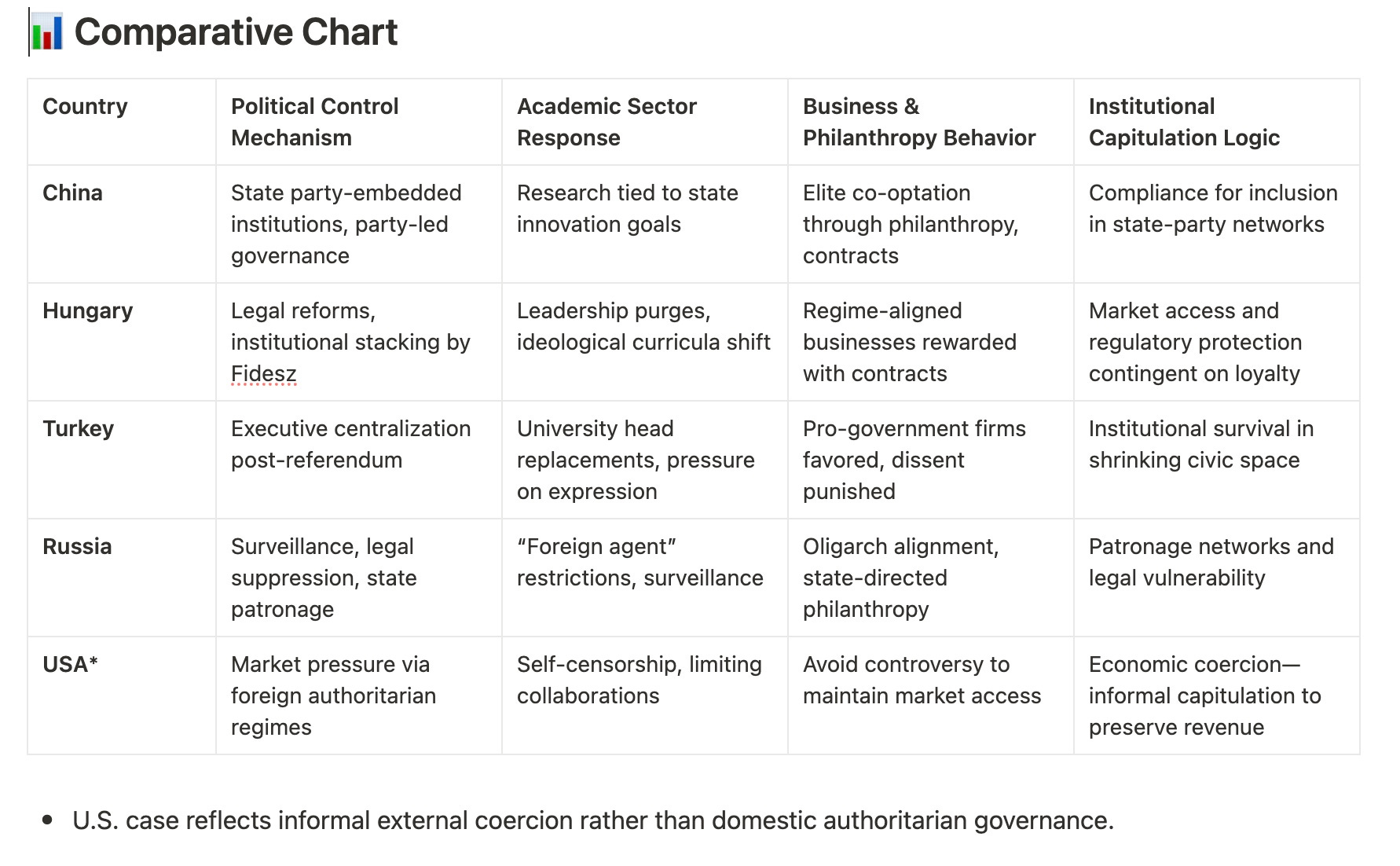
As we seek to place the experience of the United States in a global context, it may be helpful to flag the experience of other nations around the world and compare our own process of capitulation:
China
In China, state capitalism and algorithmic governance fuse political control with elite incorporation. Private business leaders often comply with party directives through corporate philanthropy and technology-sharing, cementing their status in regime-aligned networks (Taylor & Francis Online, Academia, ResearchGate). Universities and research institutions function within a system of brokered dependency, where access to funding and academic prestige depends on loyalty to state ideology. Autonomous research agendas are de-prioritized in favor of state-aligned innovation goals (SAGE Journals, arXiv). Institutions capitulate not under physical coercion, but through intertwined economic incentives, bureaucratic dependence, and embedded institutional norms that favor regime alignment over autonomy.
Hungary
After 2010, Orbán’s Fidesz party restructured institutions, filling state audit offices, the judiciary, media regulators, and the central bank with loyalists. Independent oversight bodies were effectively neutralized (Wikipedia). Academic institutions like CEU and opposition media outlets faced legal restrictions, license revocations, or forced sale to government-aligned business allies. Leaders within remaining universities complied by reshaping curricula and internal governance to reflect nationalist narratives (Cambridge University Press & Assessment, Foreign Policy, Journal of Democracy). Economic actors benefited from low taxes, state contracts, or media ownership but only if aligned. Business and philanthropic elites capitulated to preserve market position and access to public goods under authoritarian capitalism (Transnational Institute, Wikipedia).
Turkey
In Turkey, Erdoğan’s regime has centralized executive authority post‑2017 constitutional referendum. Electoral misconduct and coercive practices have weakened democratic institutions and silenced opposition through legal and political pressure (arXiv). Universities have come under state influence via leadership purges, ideological vetting, and restrictions on freedom of expression. Academic leaders often comply or preempt internal dissent to ensure institutional survival. Civil society organizations face similar pressure (Cambridge University Press & Assessment). Business elites likewise align: pro-government conglomerates receive favorable regulatory treatment, while independent firms face audits or investigations. Institutional capitulation arises from a survival calculus amid shrinking autonomy.
Russia
In Russia, Putin’s regime co‑opts media, courts, universities, and NGOs through legal restrictions, surveillance, and symbolic co-optation. Institutional leaders either toe the line or risk closure, exile, or arrest. Academic and philanthropic sectors are constrained by “foreign agent” laws and restricted funding, forcing internal compliance. Business leaders are drawn into state networks through oligarch patronage—alignment ensures access and impunity. Judicial institutions serve regime narratives through manipulated rulings; independent courts are marginalized. Institutional capitulation becomes structural: systemically advantageous for elites, punitive for dissenters.
United States
While formally democratic, U.S. institutions have historically capitulated to authoritarian-aligned pressures when economic or reputational stakes are high. For example, in the past major firms adjusted policies to market expectations, effectively self-censoring on human rights issues to avoid Chinese retaliation (Axios). Academic institutions join in targeted compliance: limiting thematic research collaborations, restricting visiting scholars from contentious nations, or canceling events to avoid political backlash. University leaders prioritize donor alignment and access over academic integrity. Although not state‑directed authoritarianism, business and academic institutions voluntarily compromise principles to preserve funding, market access, or institutional growth—revealing how informal coercion shapes institutional behavior.
And today, we witness a daily drum beat of capitulation to the demands of our current president across diverse sectors such as academia, law, and philanthropy, to name but a few—even as many in these communities are also discovering ways to respond, often “under the radar,” to affirm and advance what they feel are their core values and central practices. That said, their not speaking up and challenging the regime affirms, enables and advances the interests of that regime. Our leaders and the “elites” who claim to represent us have failed our nation in a substantial manner.
What do these experiences teach us?
These examples share a pattern: capitulation may yield short‑term gain—contracts, market access, or safety—but legitimizes authoritarian power and sets a precedent for further erosion.
Economic integration becomes leverage: regimes weaponize access; those who concede once find it harder to push back later.
Normalization via cooperation: when firms or publics quietly comply, autocrats gain credibility even in democratic contexts.
Bureaucratic rationality masks moral harm: for businesses or officials, incremental compromise appears innocuous—but aggregates into systemic capitulation.
How should democratic societies respond?
Early and consistent accountability: Democracies must refuse to normalize authoritarianism, even through quiet economic toleration.
Solidarity and coordination: Civil society, workers, investors, and politicians need to unite—not free‑ride—to resist repression.
Diversify and decouple: Businesses deeply dependent on authoritarian states (e.g. single‑market exposure) must explore diversification to reduce leverage (act-global.com).
Support alternative narratives: Independent media, alternative institutions, and international NGOs help off‑set state propaganda.
Enforce ethical cost: Public pressure, regulation, and reputational risk raise the cost of capitulation—deterring cozy relationships with autocrats
Conclusion
Capitulation to authoritarian figures arises through fear, rationalization, and coordination failure—with transformative consequences. Each case shows us that yielding grants power: politically, economically, and morally. When leaders or institutions look away—or worse, enable repression—they seed authoritarian strength.
The challenge is not abstract but recursive:
Can democratic actors summon collective courage before compromise becomes complicit?
Traditional American—if not, human—values demand we do what harms no one, deceives no one, and preserves dignity for all. Capitulation fails that test.
Only through principled resistance, transparency, and collective accountability can democracy hope to withstand the allure—and the force—of strongmen.
What is at stake here is not partisan preference but the moral architecture of governance.
Each moment of democratic compromise—be it forced loyalty tests, compromised media, American state-owned enterprise or institutional bypasses—erodes public trust. Citizens come to expect service to the ruler, not to their fellow citizens. When democracy is seen as broken, any alternative is rationalized as necessary, even if it diminishes rights.
To confront these converging pressures, the following are essential:
Rebuild representation: electoral and party reforms that restore voice.
Strengthen institutions: judicial independence, media autonomy, civil society support.
Address inequality: economic policies that reduce stratification and restore mobility.
Regulate platforms: counter disinformation and algorithmic reinforcement without censorship.
Deep structural transformation is required—beyond our acts of resistance. Democratic resilience emerges not from fear alone, but from clarity: naming moments when democracy fails us, refusing to normalize partial authoritarianism, and reinvesting in dignity—not expedience.
Sit with these thoughts the next time you find yourself reading the news, wide eyed, or scrolling through your feeds, wondering what is wrong with this country and what we have become.
And then stand up and act!
Personal Challenge:
When you consider multiple examples of capitulation with which you are familiar, how have they played out at the individual, organizational or community level?
Can you track the decision-making process by which the person or group your reflecting upon opted to capitulate as opposed to engage?
Is capitulation an all or nothing affair or can one capitulate by degrees, depending upon the context and situation?
As you reflect upon how the impact investing community has opted not to engage with and challenge the evolving context and circumstance of the present moment, how do you feel we have acted? How do you think we might respond in the future if we choose to challenge the emerging regime?
Author’s Note: While the final writing and analysis are my own, please know I did make use of various AI tools in research and drafts conducted for this project. For a fuller discussion, please see the closing Note in the first post of the Antidote to Autocracy series. Thanks!
Jed, thank you for this post.
One comment on the Corporate Capitulation. I don't see it as capitulation. The Oligarchs are the Autocrats. The Mad King is an autocract's trope, their sacrificial lamb. To suggest that the oligarchs are capitulating is to suggest some other, preferred way of being and in this context, it suggests they have a more moral or ethical way of being. I don't think these oligarchs see anything other than opportunity in this moment. They aren't capitulating to anything.
As to impact investors, the current behavior feels to me like an echo of the "double bottom line:, "do good while doing well", and "you have to keep the lights on". All of these were capitulation to profit over impact. The field has always held social change as the thing you do with your profits. The idea that the act of making the product or providing the service was inherently impactful has always been carried more by marketing than by sales. This doesn't mean that it is bad, but it does foreshadow the capitulation we see now. And the reality is that social entrepreneurs are far more tightly bound to the impact that is codified in their business models than are their funders whose impact is penciled into the margins of their vision statements.
Finally, I think there is another area of capitulation that is worth exploring and that is education. A brilliant recent book by Agustina Paglayan, Raised to Obey, explores the global history of compulsory education and documents a compelling case that the tactical purpose of Education is social control. I left social enterprise work because I saw that children were being indoctrinated (the right is, once again, essentially right but directionally wrong). Children are being indoctrinated into being Capitalist Consumers and are actively having their agency stolen. (I know, big hippie vibes. Have you read the Port Huron Statement 1962 recently? ) Add to that the discoveries of Behavioral Economics (Kahneman and Duflo/Banerjee) which have radically shifted the Capitalist goal of providing value to the consumer to the goal of extracting value from the consumer, and it becomes clear that behavioral manipulation is a major piece of this puzzle.
Thank you for providing this space!