
Post #21: Refuge From Autocracy?
Refugee Lens Investing in the Antidote to Autocracy Toolkit

This post is co-authored by John Kluge and Jed Emerson
Summary Overview
A fundamental premise of the AtA Series is that capital innovation and systems change have significant potential to decrease the energy fueling our drift to American authoritarianism. A future post will explore specific examples of how this might be done through innovations in ownership and investing practices.
This essay explores the thematic application of capital innovation by discussing how refugee lens investing (RLI) serves as a practical tool for defending democratic values in an authoritarian moment. We examine the February 18, 2026 DHS memo targeting legal refugees as a case study in how governments weaponize legal status—and how economic integration creates resilience that transcends political cycles.
In Part One, we examine the historical pattern of legal status fragility and the limits of status-based protection in authoritarian contexts.
In Part Two, we present the refugee lens investing framework as a mainstream economic response to authoritarian overreach—drawing on data from Uganda, the European Union, and the United States to show how private capital creates democratic resilience.
In Part Three, we offer concrete actions for impact investors, family offices, and foundations seeking to deploy capital in ways that strengthen both economic returns and democratic norms.
And, of course, we conclude with a rousing call to engage in Refugee Lens Investing as a tool to be used in our work to overcome the rise of American authoritarianism!
A Wake-Up Call from DHS
On February 18, 2026, the Department of Homeland Security issued a memo that should alarm anyone who understands how authoritarian power works.
The directive authorizes Immigration and Customs Enforcement to detain legal refugees—people who were vetted, admitted lawfully under U.S. refugee law, and are rebuilding their lives in American communities—simply because they haven’t yet obtained permanent residency within their first year of arrival.
These aren’t people who crossed borders illegally.
They are not individuals who failed background checks.
They are teachers, nurses, engineers, and entrepreneurs who followed every rule, passed every screening, underwent months of vetting by multiple federal agencies, and were formally admitted to the United States as refugees.
And now they are being told:
Return to custody for “re-vetting,” or ICE will find you and arrest you.
In Minnesota alone, 5,600 refugees—many from Somalia, Ecuador, and Venezuela—face potential detention under this policy. A federal judge temporarily blocked the policy in late January after ICE arrested dozens of refugees, including children, prompting legal challenges from organizations like the International Refugee Assistance Project.
This is what happens when governments treat legal status as conditional rather than earned or a natural human right—when political winds shift and protections that seemed secure suddenly become subject to retroactive “review.”
But here’s what much of the humanitarian community is missing in its rightful outrage over this policy:
The DHS memo doesn’t just threaten refugees. It reveals the fundamental fragility of status-based protection in an authoritarian moment. And it demonstrates why economic integration—specifically, refugee lens investing—must be understood as a critical tool in democracy’s defense.
Let us explain why.
Part One: The Fragility of Legal Status in Authoritarian Contexts
1. How Legal Status Alone Fails as Protection
For seventy-five years, the U.S. refugee resettlement system operated on a straightforward premise: If you proved persecution under the 1951 Refugee Convention, passed extensive vetting by multiple federal agencies, and were formally admitted to the United States, you earned legal protection.
The system had inefficiencies and limitations, but rested on a foundation of legal security codified in the Immigration and Nationality Act. Once admitted as a refugee, you had rights. You could work legally. You could build a life. After one year, you applied for permanent residency—a standard administrative timeline, not a probationary period.
The February 18 memo reverses a 2010 Department of Homeland Security policy that explicitly stated failure to adjust to permanent resident status within a year was not grounds for detention or removal. The new directive claims refugees who haven’t obtained green cards represent “public safety and national security risks” requiring renewed detention and inspection.
This reinterpretation of existing law reveals what authoritarian governments always eventually demonstrate:
Legal status alone is a fragile shield.
While legal status/papers are necessary they are not sufficient protection in an authoritarian context. What refugees also have (or can build through economic integration) is:
Economic power: Owning businesses that employ neighbors, creating mutual dependency
Social capital: Community ties that make persecution visible and costly
Financial assets: Savings, property, business equity that create leverage
Institutional relationships: Credit histories, contracts, business licenses that embed them in systems
The Feb 18 memo shows legal status can be reinterpreted retroactively. But it is much harder for ICE to quietly detain a business owner who employs 15 people than someone solely dependent on government-granted status. Economic integration doesn’t replace legal protection—it creates friction that makes persecution more difficult to execute.
The challenge presented by authoritarian regimes is there are no guarantees and there is no protection. Therefore, we must seek to make their work harder and we can develop stronger reservoirs of social capital partnership across communities. The stronger they are the harder these things are to break.
When political will shifts, protections that seemed permanent can be retroactively reinterpreted, narrowed, or eliminated entirely.
2. Historic Patterns of Status Erosion
We have been here before. American history offers sobering precedents:
Japanese American Internment (1942-1945): Over 120,000 people—two-thirds of them U.S. citizens—were forcibly removed from their homes and detained in camps. Their legal status, including birthright citizenship (the most secure form of protection in our constitutional system), didn’t save them when the government decided they posed a security risk based solely on ancestry.
Denaturalization Campaigns (1950s): During the McCarthy era, naturalized citizens deemed communist sympathizers faced denaturalization proceedings. The government retroactively questioned whether they had truthfully disclosed political affiliations during their naturalization process, seeking to revoke citizenship that had been formally granted years earlier.
Operation Wetback (1954): Over one million people—including U.S. citizens of Mexican descent—were deported under a program often ignored due process. Legal status provided little protection when enforcement agencies operated with broad discretion and minimal oversight.
Post-9/11 Detentions (2001-2003): Over 1,200 non-citizens, primarily from Muslim-majority countries, were detained without charges under “special interest” designations. Many were legally present in the United States. Their legal status didn’t prevent prolonged detention without access to counsel or clear legal process.
The pattern is consistent:
When governments adopt security-first frameworks and face minimal institutional resistance, legal status becomes conditional. The goalposts move retroactively.
This is the context in which 5,600 Minnesota refugees now face detention—not because they violated law, but because the administration has reinterpreted what their legal admission actually means.
3. Why Status-Based Advocacy Has Structural Limits
Most advocacy organizations responding to the February 18 memo are focusing on legal challenges. They’re filing lawsuits, arguing the policy violates the Administrative Procedure Act, citing the 2010 memo as binding precedent.
This is necessary work. Legal resistance matters.
But it’s also insufficient—because legal victories are themselves fragile in authoritarian contexts.
Federal judges can issue temporary injunctions. Appeals courts can affirm or reverse. The Supreme Court can ultimately decide. But judicial outcomes depend on judicial independence—a norm that itself comes under pressure when authoritarianism rises.
And even when advocates win in court, the underlying dynamic remains: Refugees whose only protection is legal status granted by the state remain vulnerable to the state’s changing definition of who deserves protection.
This is where economic power becomes essential—not as replacement for legal protection, but as a parallel system that creates resilience independent of government goodwill.
Part Two: Economic Integration as Mainstream Democratic Response
1. The Historic Role of Economic Pressure in Confronting Authoritarianism
As discussed in previous posts in the Antidote to Autocracy series, economic pressure has historically proven one of the most effective tools against authoritarian overreach. For example:
The Montgomery Bus Boycott (1955-1956) demonstrated how coordinated economic action could challenge systemic oppression—not through violence, but through the strategic withdrawal of economic participation.
The United Farm Workers’ grape boycotts (1965-1970) showed how consumer solidarity could support labor rights and force structural change in agricultural power dynamics.
International divestment campaigns during South African apartheid helped isolate the regime economically, contributing to its eventual collapse. Pension funds, university endowments, and institutional investors withdrew capital, creating economic consequences that political pressure alone couldn’t achieve.
Why does economic pressure work where legal or moral arguments fail?
It works because authoritarian governments can revoke legal status, suppress dissent, and control narratives—but they struggle to dislodge economic contributions that have become essential to community prosperity.
This principle applies directly to refugee integration.
2. What Economic Integration Actually Means
When we talk about economic integration for refugees, we’re not describing charity or corporate social responsibility initiatives. We’re describing refugees becoming embedded in their communities as economic actors whose success creates mutual benefit.
Consider what economic integration looks like in practice:
Refugees as employers: Instead of being someone whose legal status depends entirely on government decisions, a refugee business owner employs neighbors—creating jobs, generating tax revenue, anchoring commercial districts.
Refugees as taxpayers: According to research by New American Economy, refugees admitted to the U.S. between 2005-2014 paid $63 billion more in taxes than they received in benefits over their first 20 years. They’re net fiscal contributors, not drains.
Refugees as investors: Refugees with 13% entrepreneurship rates (compared to 9% for native-born Americans) deploy capital, take risks, and create enterprises that wouldn’t otherwise exist.
Refugees as creditors: Financial inclusion data from Kiva shows refugee borrowers maintain 96.6% loan repayment rates—matching non-refugee borrowers and challenging deficit narratives about creditworthiness.
Refugees as community anchors: In cities like Salt Lake City, Minneapolis, and Columbus, refugee-owned businesses have revitalized declining commercial corridors, attracted additional investment, and created the kind of street-level economic activity that supports broader neighborhood stability.
This isn’t rhetoric. It’s measurable economic contribution.
And here’s the democratic protection mechanism:
When ICE shows up to detain a refugee who’s been legally present in our communities, they’re not just arresting an individual. They’re disrupting an employer, removing a taxpayer, destabilizing a business that serves the community.
The economic and social costs ripple outward—and those costs create friction that makes persecution harder to execute quietly.
3. Why This Constitutes a “Mainstream” Response
In the Antidote to Autocracy framework, “mainstream” responses are those that work within existing systems to strengthen democratic norms rather than seeking to overthrow structures entirely.
Refugee lens investing (RLI) fits this definition precisely:
RLI operates through existing capital markets: No new institutions need to be created. Impact investors, family offices, foundations, and DFIs can deploy capital through existing vehicles and frameworks.
RLI aligns with market incentives: Investors aren’t asked to sacrifice returns. The data shows refugee lens investments generate competitive financial returns alongside social impact—textbook blended value.
RLI strengthens rather than challenges institutions: When refugees become business owners, taxpayers, and employers, they reinforce the economic institutions that democracies depend on—property rights, rule of law, contract enforcement.
RLI creates constituencies for continued openness: Business owners, chambers of commerce, and economic development agencies become advocates for policies that support refugee economic integration because it serves their interests.
Compare this to the humanitarian aid model, which positions refugees as recipients of government services and charity. That model creates dependency relationships where refugees’ well-being depends entirely on political goodwill.
When political winds shift hostile—as they have in 2025-2026—those dependent on government support find themselves with no leverage, no alternative systems, and no economic power to complicate government persecution.
Economic integration, by contrast, creates what we might call democratic friction through economic entanglement—and in that way becomes an effective tool to counter the negative effects of American authoritarianism.
RLI doesn’t make persecution impossible.
But it makes it more costly, more visible, and more complicated to execute.
Part Three: The Refugee Lens Investing Framework
1. Defining the Investment Categories
Most people hear “refugee investing” and think exclusively of microloans to refugee entrepreneurs. That’s an important category, but it captures only a fraction of the opportunity.
Refugee lens investing (RLI) is a systematic approach to capital deployment across six categories that span the full spectrum of displacement economics. These categories were developed through research conducted by the Refugee Investment Network analyzing investment flows and economic integration patterns across Uganda, Jordan, Mexico, the European Union, and the United States.
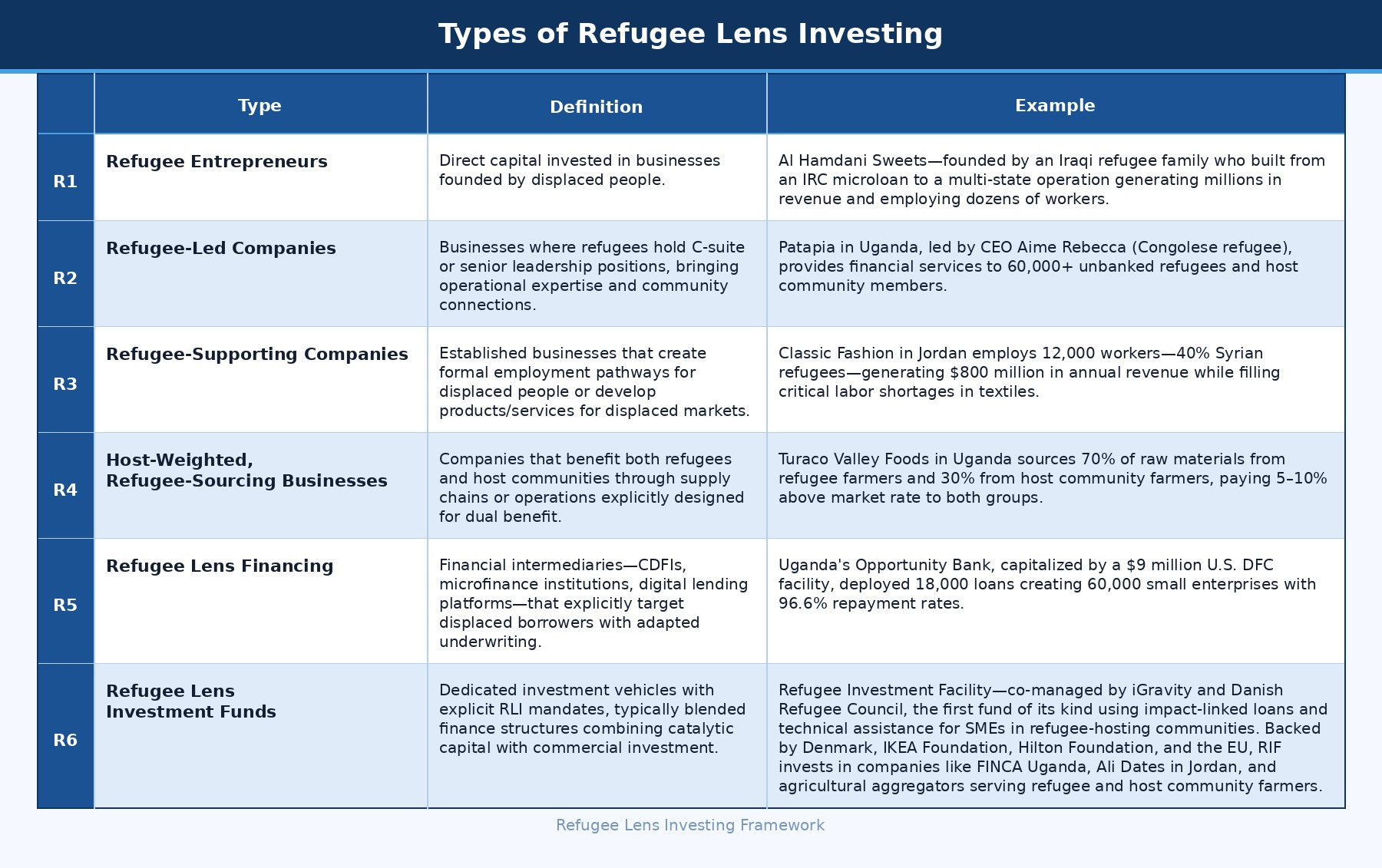
What unites these categories is a fundamental reframe that should sound familiar to readers of The Purpose of Capital:
Refugees aren’t aid recipients. They are economic actors who generate blended value—creating financial returns for investors while strengthening social infrastructure and economic resilience in host communities.
This is the classic blended value framework applied to displacement economics.
2. The Evidence Base: Investment-Grade Data
The refugee lens investing thesis isn’t aspirational. It’s backed by rigorous data from multiple markets:
Uganda (R5 Lending Facility):
The U.S. Development Finance Corporation’s $9 million facility to Opportunity Bank enabled lending to both refugees and host community members in a country hosting 1.5 million displaced people. Results: 18,000 loans deployed, 60,000 small enterprises created, 96.6% repayment rate.
Kiva Global (R5 Platform):
Kiva’s Refugee Investment Fund deployed $40.7 million to 51,400 refugee borrowers across 45 countries. Repayment rate: 96.6%—statistically identical to non-refugee borrowers, disproving the “risky borrower” narrative.
European Union / Ukraine (R1 Entrepreneurship at Scale):
When the EU granted 4.3 million Ukrainian refugees immediate right to work through the Temporary Protection Directive, displaced entrepreneurs launched 25,000 businesses in Poland alone within the first year. These businesses filled labor shortages, paid taxes, and contributed to economic growth—all while maintaining their legal status as displaced people.
United States (R1 Historical Performance):
Research by New American Economy shows refugees in the U.S. have:
13% entrepreneurship rate (vs. 9% for native-born Americans)
$63 billion net positive fiscal contribution over 20 years for cohorts admitted 2005-2014
$25 billion in taxes paid in 2019 alone
Lower crime rates than native-born citizens across all categories
Jordan (R3 Refugee Employment):
Entire sectors demonstrate that refugee hiring isn’t corporate charity—it’s strategic workforce development. Jordan’s garment sector employs over 75,000 workers and generates $2 billion in exports. Under the EU-Jordan trade agreement, companies hiring Syrian refugees (including over 1,800 placed through ILO employment centers) gain preferential access to European markets.
This isn’t cherry-picked data. These are consistent patterns across geographies, sectors, and investment types showing that when displaced people access capital and formal economic opportunity, they generate returns and build prosperity.
3. Why the Model Works: Incentive Alignment
Refugee lens investing succeeds where aid fails because it aligns incentives rather than creating dependency.
For investors: Market-rate returns with demonstrated downside protection plus measurable social impact.
For refugees: Access to capital, formal employment, and economic opportunity that builds assets and resilience rather than perpetuating aid dependency.
For host communities: Job creation, tax revenue, filled labor shortages, and economic activity that benefits host-community members directly (as seen in Uganda’s host-weighted sourcing models).
For governments: Reduced fiscal burden (refugees become net taxpayers), increased economic growth, and solutions to labor market gaps—all without expanding government budgets.
This is classic blended value thinking: When incentives align across stakeholders, systems become self-sustaining rather than requiring ongoing philanthropic or governmental subsidy to function.
Part Four: Mainstream Actions for Impact Investors
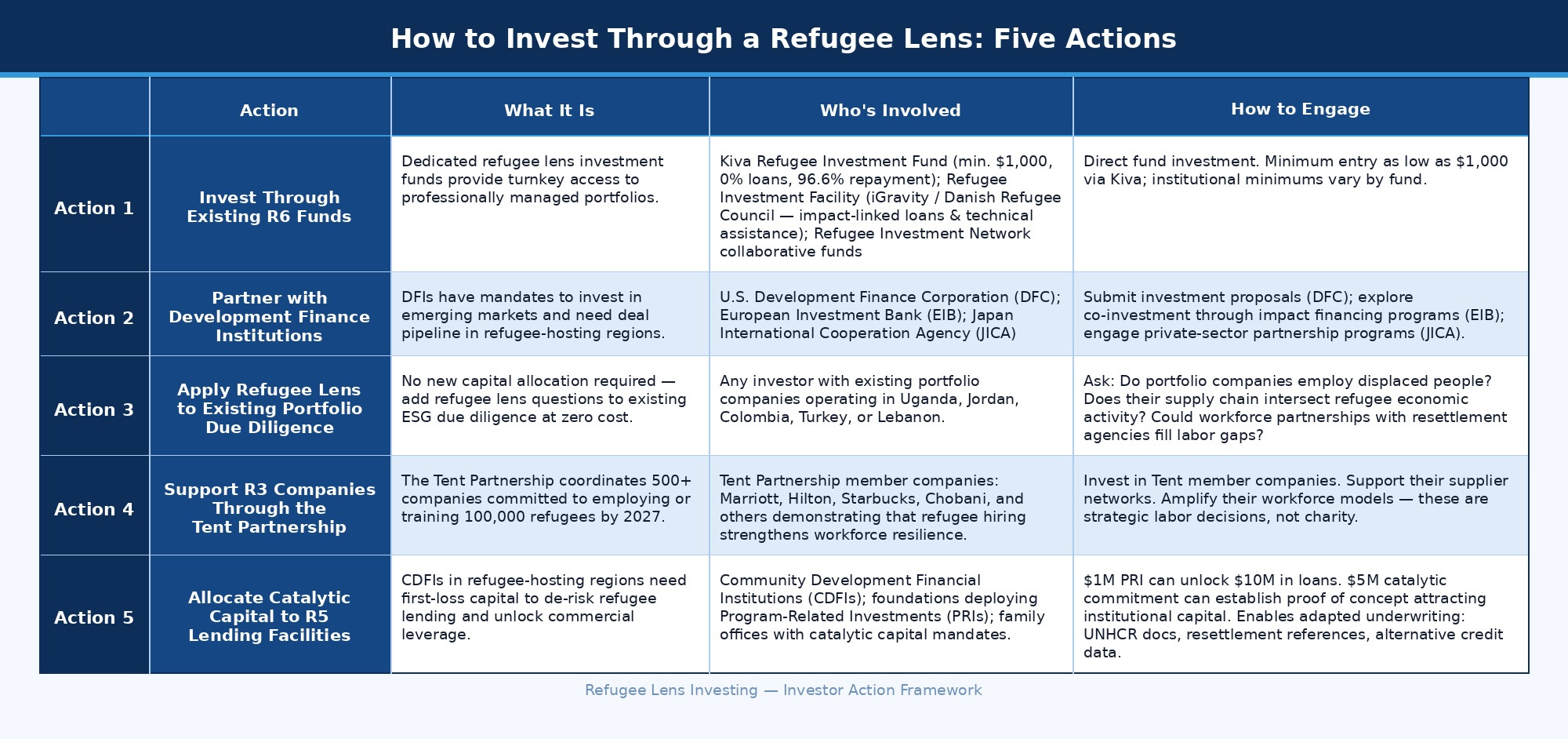
1. Immediate Opportunities for Capital Deployment
If you’re reading this as an impact investor, family office manager, foundation program officer, or institutional allocator, here’s what the February 18 memo should tell you:
The humanitarian aid model is structurally failing.
Not just in the United States, but globally. Traditional resettlement funding has been slashed. Faith-based organizations like Catholic Relief Services and the International Rescue Committee are hemorrhaging capacity. The number of forcibly displaced people continues to grow (123 million as of mid-2024) while support systems shrink.
Private capital is the only sustainable alternative at the scale required. And the infrastructure to deploy it already exists.
Five concrete steps toward leveraging RLI that you can take in the next 90 days:
2. Building Long-Term Infrastructure
Beyond immediate investment opportunities, the impact community should consider longer-term infrastructure needs:
Measurement Frameworks: We need industry-standard approaches to measuring RLI impact across the R1-R6 categories. Organizations like the Global Impact Investing Network should incorporate refugee lens metrics into IRIS+.
Deal Flow Pipelines: More systematic connections between refugee-serving organizations (IRC, UNHCR, resettlement agencies) and impact investors. These organizations have deep community relationships but often lack investment expertise.
Risk-Sharing Mechanisms: Blended finance structures that use catalytic capital to de-risk commercial investment in refugee contexts, similar to models pioneered in climate adaptation finance.
Policy Advocacy: While private capital is essential, supportive policy matters. Advocate for work permit reform, banking access for refugees, and DFC/USAID engagement with refugee lens opportunities.
3. Why This Matters for the Broader Impact Community
Some may be thinking: “My impact thesis is climate” or “We focus on health equity” or “Our mandate is education.” Why should you care about refugee lens investing?
Three reasons:
1. Displacement is accelerating—and it intersects with every impact thesis.
Climate displacement. Conflict-driven displacement. Economic displacement. By 2030, the International Organization for Migration estimates 200+ million people will be forcibly displaced. If you’re investing in climate adaptation, public health, education systems, or economic development—you’re already intersecting with displacement whether you acknowledge it or not.
2. RLI demonstrates how impact investing serves as antidote to authoritarianism.
If you accept the premise that impact investing can be a tool for strengthening democratic norms (as argued throughout this Antidote to Autocracy series), then refugee lens investing is a perfect case study. It creates economic integration that makes persecution more costly. It strengthens institutions. It generates data that counters xenophobic narratives.
3. The February 18 memo is a warning about how quickly “secure” legal status can become conditional. Today it’s refugees. Next year (or tomorrow) it could be different marginalized groups. Building economic power as parallel protection isn’t just about refugees—it’s about creating resilience systems that transcend political cycles.
This is the approach that will allow us to deploy innovative impact capital to capture refugee investing opportunities as part of our coordinated response to the rise of American authoritarianism.
Conclusion: From Outrage to Action
The February 18 DHS memo targeting legal refugees is an outrage. We should say so clearly. We should file lawsuits. We should defend the principle that legal status, once earned through extensive vetting and formal admission, shouldn’t be arbitrarily revoked.
But we should also do something more:
Build the system where 123 million forcibly displaced people globally aren’t waiting for governments to decide their fate.
Refugees around the world are moving to access capital, build businesses, create jobs, and integrate into economies as contributors who generate blended value—financial returns alongside positive social and environmental impact.
Their economic power creates democratic friction that makes persecution harder to execute quietly.
Our impact investing may consistently serve its highest purpose: not simply generating financial returns, but strengthening the economic and social infrastructure democracies depend on.
As we wrote at the opening of this essay, legal status alone has proven fragile throughout American history. Economic power, while not guaranteeing safety, creates resilience that transcends political cycles.
The tools exist. The data proves effectiveness. The infrastructure is ready.
However, before we rush to deploy capital, we need to pause—not to delay action, but to ensure our action emerges from clarity rather than habit. In the spirit of what Jed has called praxis throughout this series, let us first reflect, then act with intention.
Personal Challenge
If you’re reading this as an impact investor, family office manager, foundation program officer, or institutional allocator, we invite you to sit with these questions as personal challenge for you to consider before you act:
1. What’s my tolerance for market-building risk versus market-rate returns?
RLI opportunities range from near-market-rate debt to higher-risk/higher-impact equity in refugee-led ventures. Where does your mandate sit on this spectrum? Are you deploying catalytic first-loss capital, or seeking competitive risk-adjusted returns? The beauty of RLI is that it offers entry points across the entire risk-return continuum—the question is which door you choose to walk through first.
2. How do I evaluate displacement-specific operational challenges?
Documentation barriers, language and cultural factors, and legal status complications are real. Do you have partners with on-the-ground expertise to navigate these complexities? Are you structuring deals to account for longer timelines and different risk profiles than traditional impact investments? This isn’t charity work—it’s market-building in contexts where the infrastructure may be incomplete. Success requires humility about what you don’t know and partnerships with those who do.
3. What refugee lens exposure exists in my current portfolio—and how can I activate it?
Before making new investments, examine what you already own. If you’re investing in emerging markets or refugee-hosting countries, you likely have portfolio companies already touching displaced populations—whether they realize it or not. Refugees under UNHCR’s mandate are recorded as living in over 190 countries and territories worldwide, meaning nearly every country hosts at least some refugees or asylum-seekers, so the chance is higher than you might think. Does your affordable housing developer consider refugees viable tenants? Could your fintech platform serve displaced entrepreneurs who lack traditional credit histories? Your microfinance institution may already be lending to refugees without tracking it.
Use your influence as an investor to help portfolio companies recognize displaced populations as underserved markets, not charity cases. Connect them with local resettlement agencies, help them adapt products to serve documentation-challenged customers, facilitate partnerships that turn their existing services into refugee lens use cases. The infrastructure is already there—sometimes you just need to help your teams see the opportunity.
4. What needs to change in you to advance economies of belonging?
It’s easier to deploy capital than to examine the assumptions that guide where we deploy it. The first three questions asked about your risk tolerance, your operational readiness, your portfolio activation strategy—all important tactical considerations. But here’s the deeper question: What mindset shift would allow you to see refugee economic integration not as impact investing’s newest sector, but as fundamental to building economies where anyone can belong?
This isn’t about adding one more cause to your portfolio.
It’s about recognizing that 123 million forcibly displaced people aren’t a humanitarian crisis happening “over there”—they’re a structural exclusion from the global economy that makes all our markets less resilient, less innovative, and ultimately less secure. The February 18 memo should remind us: legal status alone has never been sufficient protection. Economic integration isn’t charity. It’s the infrastructure that makes persecution costly, visible, and complicated to execute.
Sit with this discomfort:
How much of your investment thesis rests on assumptions about who deserves to participate in markets?
What would you need to let go of to build economies where belonging isn’t conditional on legal status, country of origin, or government approval?
The only question that remains is:
Will we deploy capital at the scale and speed this moment demands?
123 million people can’t wait for governments to decide they’re worthy of protection.
They need economic opportunity now. They need access to capital now. They need investors who understand that building their economic power isn’t just good for returns—it’s good for democracy.
Refugee lens investing is impact investing at its best: generating competitive financial returns while creating the economic integration that makes democratic societies more resilient to authoritarian impulses.
Let’s get to work!
FOR READERS INTERESTED IN TAKING ACTION:
Learn more about refugee lens investing: Visit bankingonbelonging.com and refugeeinvestments.org
Explore Jed’s full “Antidote to Autocracy” series: blendedvalue.substack.com
Ready to invest? Begin your due diligence and exploration by contacting the Refugee Investment Network or explore existing funds:
Refugee Investment Facility (iGravity/Danish Refugee Council)
Tent Partnership for Refugees (for corporate engagement)
(None of the above should in any way be construed as investment advice and should be understood as offering direction for a starting place to your own, independent investment research, decisions and journey).
John Kluge Jr. is co-founder of the Refugee Investment Network and co-author of Banking on Belonging: Why Investing in Refugee Entrepreneurs Benefits Everyone (Columbia University Press, June 2026). His father arrived at Ellis Island as a refugee and built Metromedia—later Fox television network.
Jed Emerson coined the concept of “blended value,” co-authored the first book on impact investing, is author of The Purpose of Capital digital versions of which are available for free here, and writes the Substack series “Antidote to Autocracy: Exploring the Nature of Value in a World Gone Mad.”
Author’s Note: While the final writing, analysis, and argument are our own, we made use of various AI tools in research and drafting conducted for this project. The perspectives and recommendations reflect our combined expertise in impact investing and refugee economic integration, informed by John’s decade of work building the Refugee Investment Network and Jed’s thirty years advancing blended value thinking. For fuller discussion of AI usage in the Antidote to Autocracy series, please see the closing note in the series’ first post.
This is a great analysis! I love it. I think there are also opportunities for ordinary, everyday investors to support refugees via regulated investment crowdfunding. Platforms like Honeycomb Credit and SMBX, which offer small business financing, are often led by immigrants--some of whom are likely refugees (like my dentist). SMBX allows investments as small as $10, allowing virtually anyone to participate in supporting these businesses.